

I talk again and again about the Frontier Transformation and that companies strive to become a Frontier Firm. The good news is: there are actually Frontier Firms out there. the bad news: there’s no finish line.
So why should you enter a race that’s never finished? or why even strive for something that may never end. Think back to my gym metaphor: You can strive to be fit and build muscles. That’s hard work, you need a plan, discipline and it’s not always fun. You can be the strongest woman or man on this planet, but as soon as you’re quite training you will get lose your muscles and you’re fitness will decline. Same applies for your AI transformation.
Do we still workout? Do we still care about our health? Of course we do!
The Question that sounds right, but isn’t.
You’re on track with your transformation, made good progress on the agend and then it this questions came on your mind.
“So are we a Frontier Firm now?”
It’s a paradox. It’s something you strive for like the next go-live or a project milestone that you sign off and it’s done. Unfortunately it won’t work that why, but I understand the questions, because “Bein a Frontier Firm” assumes that is something achieve like an award. It’s more like a way of thinking and acting; let’s say a philosophy that you are trying to build and keep in your organization.
You don't become a Frontier Firm. You train as one.
So the question sounds right, but is the wrong thinking model. Let’s explore what’s the right questions and thinking model instead.
If you want to get a first indicator were you stand on your journey, take the Frontier Fitness check.
The Frontier Moves
But why isn’t Frontier Firm a status that you achieve onced and have it in your trophy board? Let’s look back one month ago or three months ago or let’s say one year back, do you see the pattern? Excately, what we would claim as Frontier three months ago is maybe kind of commodity today. So being Frontier is super fluid and dynamic such as all the announcement we read every other day. Instead we are going to build an operating model that lives beyond ‘the next best AI model’ but is a solid foundation that can scale over time while being flexible enough to rebuild it when needed.
There is no finish line. The frontier moves.
With that said a Frontier Firm has more like a natural understanding that change need to be in their DNA. That the most important aspect is a dynamic mindset in the organization and this mindset allow to grow and allow people to constantely reshape their daily work.
Pattern, not Phases
The second reason why there’s no finish line: organizations don’t move through this journey in clean phases. That would be nice, right? Phase 1 done, Phase 2 done, next one please. But that’s not what I see in real projects.
What I see instead: one department is already running agent workflows in their daily business, while the department next door is still discussing if AI is allowed in meeting notes and how they restructure their meeting experience. It’s the same company, however they have a completly different reality.
And it’s not even stable. A team jumps ahead in one area and falls back in another. This whole AI transformation is a multi-layer approach. The sales team builds great habits with Copilot, then two key people leave and suddenly the habits are gone too.
So there is no single moment where the whole organization crosses a line together. And if nobody crosses a line together, there is no line. There are only patterns: behaviors that spread, behaviors that hold and behaviors that fade.
That’s why I stopped thinking in phases and started thinking in patterns.
How fluid this journey is do we experience and “feel” quite often. On LinkedIn it’s a popular sport to laugh about Microsoft’s the next rebranding or renaming. And I get it, because it’s super annonying, frustrating and confusing to people. Why does it need to be change? I’ve juts got familar with the latest update.
In my opinion it’s excately that Frontier Moves that Microsoft is doing again and again. Let’s be honest, their are not that much more experience with all this genAI stuff we are exploring every day (well of course they are, but only a few months a head not decades) and they learn every day. Based on all your feedback, exchanges with customers and so on. And they are “brave” enough to constantely change theirself and mapping all to little pieces to a large AI transformation puzzle.
An example to proof it. In the beginning of the agentic AI era, Microsoft had a slide “How to become a Frontier Transformation” on the slides were the different phases (highlighted in yellow).
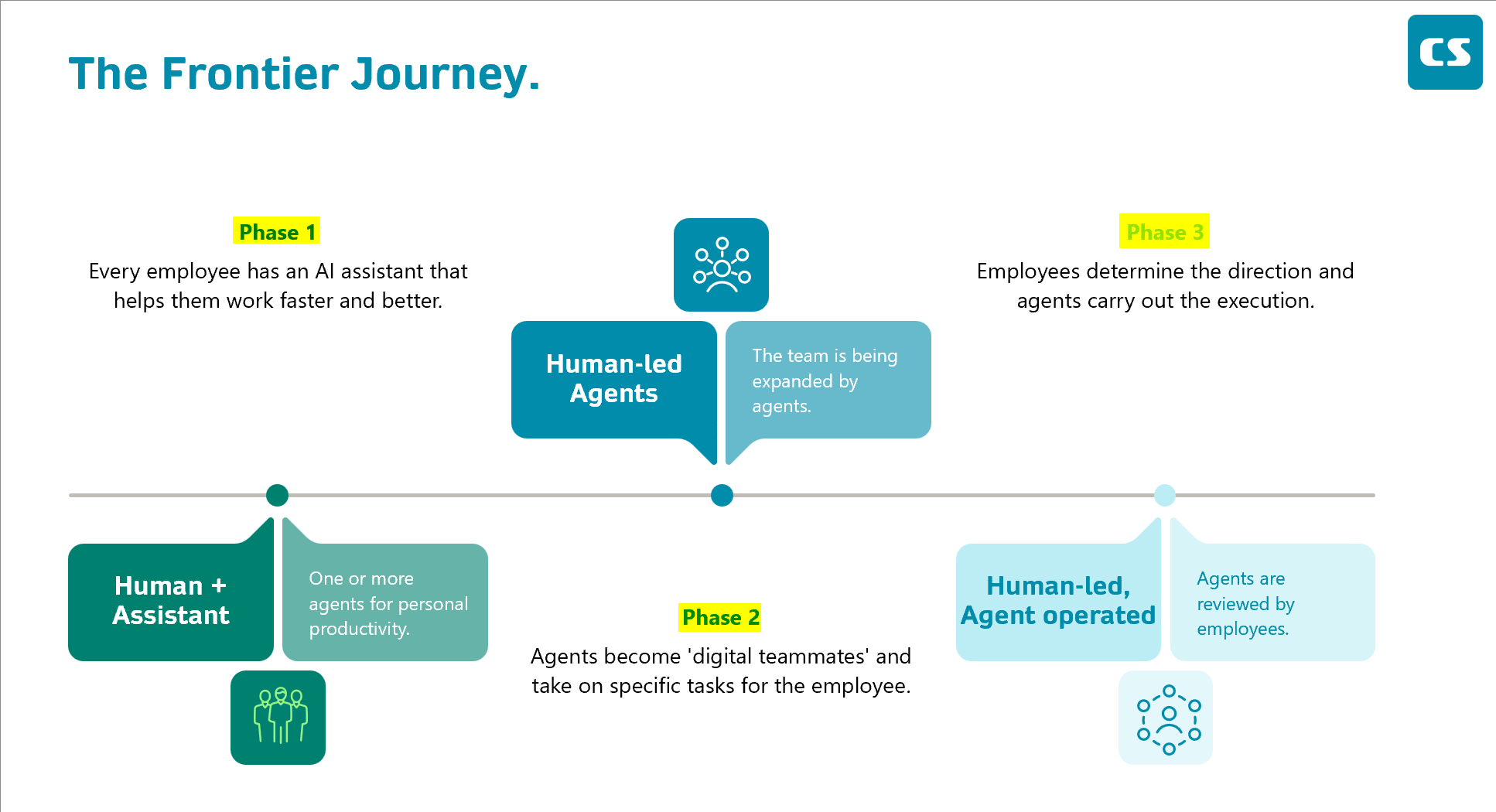
So we were thinking about of course every organization is starting with Phase 1 human + assistant. Once this is completed we’re heading to Phase 2 and so on.
But after a while we saw on the market that this is not true. Even though some organizations hasn’t started at all with phase 1, they were already in Phase 3. So we need to change this thinking model. From phases to pattern. Now it’s called Pattern 1, 2 and 3, which makes a lot more sense. So we’re all on a learning journey.
Keep going or you loose it all
If you reading through my previous episodes you know that there is one particular pattern, that I see again and again. I called it “the Copilot Plateau”: Organization made a fantastic job at the beginning, everyone was hyped with the Copilot rollout but after a while they realized “oh well we haven’t realized any value”.
Compare it with the gym. You worked that hard to become fit, increased your cardio or grow so much muscles. And then suddenly you decided “that’s enough, I have enough muscles”. Now you have to choices.
keep going to the gym and maintain your muscle
stop going and loose it all
Access isn't fitness. And fitness isn't a status.
And it happens not over night (same as it didn’t grow over night) but slowly and steady. After a few months you realize my biceps isn’t that big anymore or you realize you’re output with Copilot isn’t that great anymore.
So you (as an organization) need to keep going or you loose it all.
There’s no finish line, but you can still win.
Nobody is done training just because she or he is fit or the best in the world. It’s quite the opposite, the best ones on this planet are those you train constantely I try to become better and better. Of course, they do not train the same as a junior. But the basics are always part of the program. Same applies for your AI Transformation and become a Frontier Firm. You’re just setting the bar high and it’s still a huge benefit for organization if their in the “top right” of AI transformation. It’s maybe even a unfair advantages compared to the ones that stopped training.
FAQ: Becoming a Frontier Firm
Frequently Asked Question based on the article (AI-generated)
Isn’t “Frontier Firm” just another maturity model?
No. A maturity model has levels you complete and a top level you reach. The frontier moves — what counted as frontier behavior three months ago is commodity today. Frontier Firm describes how your organization deals with change, not which level it sits at.
If there’s no finish line, how do I measure progress?
Not by asking “are we done?” — by looking at behavior. Which patterns are spreading? Which ones hold when the champions get busy? Which ones fade? Progress shows in what people actually do differently, measured over time. If you want a first indicator, take the Frontier Fitness Check.
Doesn’t “never finished” demotivate the team?
Only if you sell it as a project that never ends. Nobody at the gym is demotivated because there’s no final workout. You train because you see results — you get stronger, you perform better. Same here: celebrate the improvements, not the arrival.
What does the practice look like in a normal week?
Small reps, not big campaigns. One question does most of the work: “What did we train this month — and what changed because of it?” Make it a standing agenda item. Review real use cases, share what worked, drop what didn’t.
How is a Frontier Firm different from a digital-first company?
Digital-first is mostly about which tools you use. Frontier Firm is about how fast you turn new capabilities into new behaviors — and how well those behaviors hold. You can be digital-first and still be stuck on the plateau.
Where do I start if my organization is on the plateau right now?
Not with another big campaign. Start training again, small: pick one team, one workflow, one habit — and make it stick before you scale. The plateau is not a technology problem. It’s a training problem.