

Here’s why you should start your frontier transformation. I’m sure I don’t have to convince you that AI is not just hype, but one of the most disruptive shifts of our time.
The main question is: Will you benefit from it, or will you struggle to keep up with your competitors as a late follower?
There are four main aspects that can be achieved through the transformation.
Enrich Employee Experience
Reinvent Customer Engagement
Reshape Business Processes
Bend the Curve on Innovation
👉🏼 These are not standalone terms; they go hand in hand. In particular, you have to rethink everything you’ve done. Of course, this is not something you can do over the weekend; it’s a journey. It’s probably one of the most important journeys for the future. Every journey starts with a first step. Today might be your first step toward understanding Frontier Transformation.👇
The Frontier Journey
We had the pleasure of meeting Jasmine Campbell and Lara Caldirola. Frontier Transformation was, of course, an important topic. One thing that really resonated with me was shifting the Frontier journey from phases to patterns. Last week, I introduced you the three phases from human-plus-assistant to human-led and agent-operated. I totally agree that there are not phases, but rather patterns. Some organizations start with Pattern 2 and then go back to Pattern 1. Now, let’s take a closer look at the different patterns.
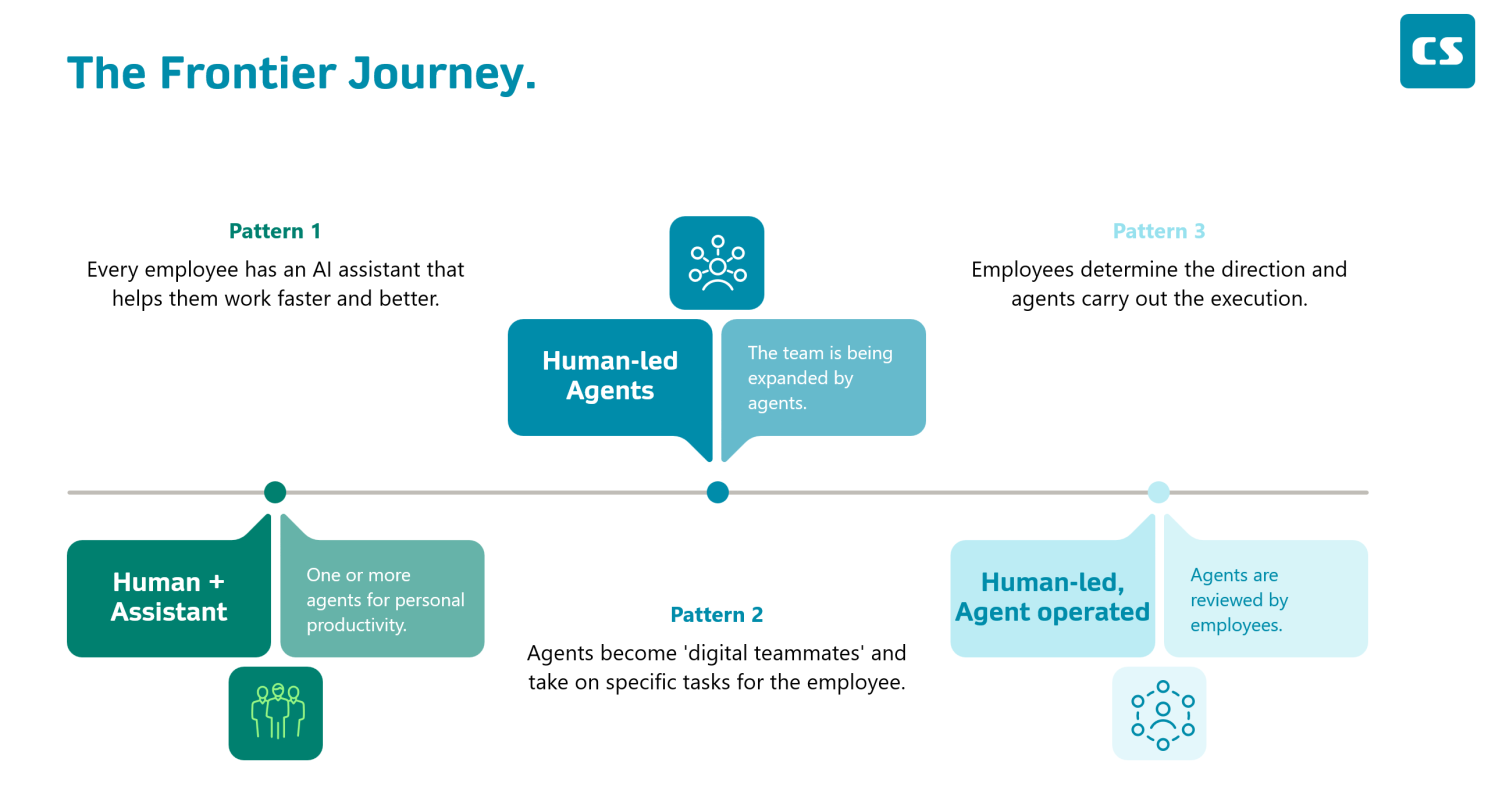
Pattern 1: Human + Assistant
I guess “Human + Assistant” is the most intuitive one. That’s because most of us have already experienced it. We’re doing the same tasks, but with AI assistance. This helps us speed up and improve the quality of our daily tasks, also known as “personal productivity.”
One thing to remember is that I’ve had many discussions with C-level executives about the return on investment of AI in the field of personal productivity. But that’s the wrong question. If you’re interested in the details, please read my blog post: Copilot in Practice: Why ROI Isn’t the Most Important Question | Campana & Schott
Personal example: One example I always showcase here is the creation of the Copilot Your Day newsletter. Every weekend, I write a new episode of Copilot Your Day. I write the text myself, with hardly any use of AI.
Why? Because I believe it makes a difference in the long run to simply write down my thoughts. However, I need to create an SEO title and description, which is definitely not my strength, nor do I have marketing expertise. That’s why I hired an agent to support me. I simply copy and paste my text, and the agent generates a title and description that are perfectly tailored to my goals and newsletter.
I could also use our Campana & Schott Content Companion Agent to support our corporate influencers in creating new posts. For example, if I’m having trouble coming up with a great hook, the agent can help. Then, I’m ready to go.
Pattern 2: Human-led Agents
Now, Pattern 2 is getting interesting because we are expanding our physical teams with digital colleagues. Agents are evolving from simply retrieving information based on a prompt to actively working alongside us, just as a coworker would. Microsoft already offers agents that fit this pattern. Consider the Facilitator Agent, which is becoming an increasingly important colleague in your meetings. It uses chat to welcome everyone and posts meeting recaps. It also helps you keep track of your agenda and takes notes in real time. The same goes for the Project Manager agent. You can assign tasks to the agent, and it will take care of them or remind other colleagues once they’re overdue. Of course, you can also start building your own human-led agents to become digital colleagues.
Pattern 3: Human-led, Agent-operated
What about pattern 3? According to the latest IDC study (IDC Info Snapshot, 1.3 Billion AI Agents by 2028, May 2025 #US53361825), there will be 1.3 billion agents worldwide by 2028. What will this mean for employees? We will become agent bosses, setting the direction of agent work and overseeing the results. However, the main work will be done through agents, allowing us to focus on important aspects of our daily work. In pattern 3, humans will lead the agents that perform most of the tasks. There will be multiple agent scenarios and interoperability between all systems. Of course, we will not be limited to Microsoft but will extend to all third-party systems.
3 Ways Becoming a Frontier Firm
One of the most common questions I receive is: “How do I start transforming my organization into a Frontier Firm?” Microsoft recently shared their experiences and offered three ways to become a frontier firm. (source: Becoming a Frontier Firm: What we are learning).
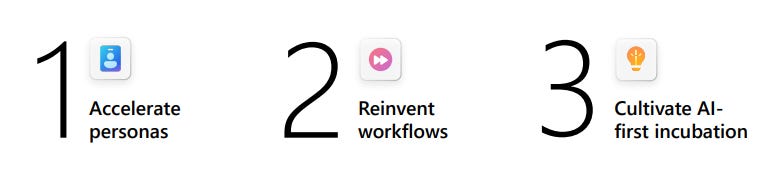
1️⃣ Accelerate Personas: Focus on specific roles and skills in an organization.
This discovers how work really gets done by uncovering persona-driven insights to redesign daily tasks with Copilots and agents and by building habits that sustain AI adoption across roles
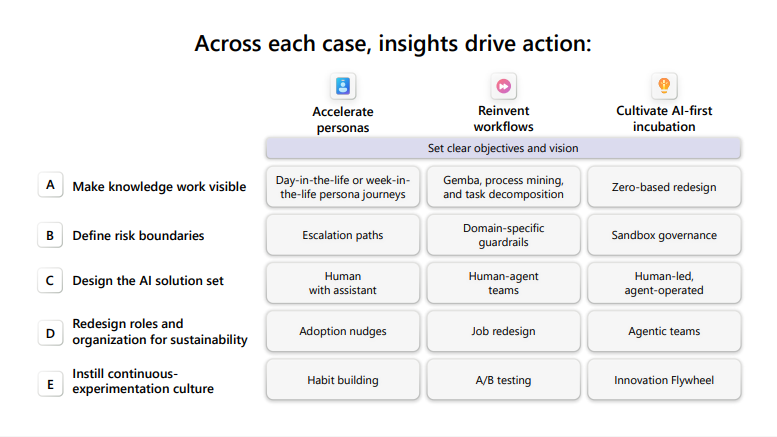
Make knowledge work visible: Day-in-the-life or week-in-the-life persona journeys journeys to map work, surface bottlenecks, and prioritize AI opportunitie
Define risk boundaries: Set clear escalation paths and decision rights (e.g., RACI) to ensure responsible AI use and trust.
Design the AI solution set: Match solutions to their context: Copilot for routine tasks, light automation for gaps, and agents for complex workflows.
Redesign roles and organization for sustainability: Use peer influencers and adoption nudges to reinforce new ways of working
Instill continuous experimentation culture: Shift from copilots to sustainable change by embedding daily use, rituals, and reinforcement mechanisms toward building habits
2️⃣ Reinvent Workflows: Enable new human-agent processes
This starts with analyzing workflows to see how work gets done, embedding guardrails, scaling AI copilots, and designing new agentic systems. From there, you can proceed to redefining human roles to enable sustainable, high-impact collaboration among humans and AI.
Make knowledge work visible: Make knowledge work visible by using Gemba walks, process mining, or value stream mapping. Apply AI driven solutions and prioritize based on ROI and strategic fit.
Define risk boundaries: Establish domain-specific boundaries by setting clear escalation paths, checkpoints, and audit controls to ensure automation is safe and trusted.
Design the AI solution set: Choose the right human-agent team approach with build-versus buy decisions, and scale copilots and agents through dedicated “agent factories.”
Redesign roles and organization for sustainability: Retrain employees for AI-era roles, update job descriptions, and evolve team structures for effective human– AI collaboration. Adopt a “test-and-learn” mindset by using structured experimentation methods to continually test and embed new AI use cases into existing workflows.
Instill continuous experimentation culture: Compare your approaches with A/B testing.
3️⃣ Cultivate AI-first incubation: Create AI-first work approaches
Here, companies start with skilled teams who are very clear about the inputs and outputs of the process they are driving. They immerse themselves in the new capabilities that AI can bring, and they start by redesigning the way that they will work together. They redefine roles and team processes as a starting point.
Make knowledge work visible: Gather an expert team together. Ask them to define the smallest and simplest way that they could imagine getting a job done.
Define risk boundaries: Question all assumptions to completely reimagine processes and create AI-first workflows.
Design the AI solution set: Put strong governance in place, like policy-as-code, so teams can experiment safely without putting the enterprise at risk.
Redesign roles and organization for sustainability: As the team starts to operate in a new way, “add back” people and agents as needed. This way, you are starting at a “zero base” to build up, rather than starting from the old process and trying to simplify down.
Instill continuous experimentation culture: Operate an innovation flywheel by piloting new ideas, conducting A/B testing, codifying what you learn, and building reusable patterns and guardrails for the future.
💡 In each case, insights drive action, helping teams, functions, and the entire organization quickly scale learnings.
My Personal Learnings
Frankly, there is no one right way, but there are several approaches to achieving it. Based on my experience, one of the key elements is starting with your employees, which strongly resonates with the concept of accelerate personas.
💡 But my key takeaway: It’s all about cultivating an AI mindset in your organization.
Too often, we discuss ROI or tool implementation, such as Copilot. While these are important, they are not the main goal. The main goal is to redefine how work is done in your organization. Before your employees start executing tasks, they should ask themselves:
How can AI/Copilot help me achieve this faster and/or better?
At the executive level, the following questions should be asked:
How can AI/Copilot help us achieve our strategic goals faster and/or more effectively?
In addition to the Microsoft approach, I would like to share my experience and explain what the journey could look like. This is especially useful if you want to start enabling your workforce with AI and Copilot.
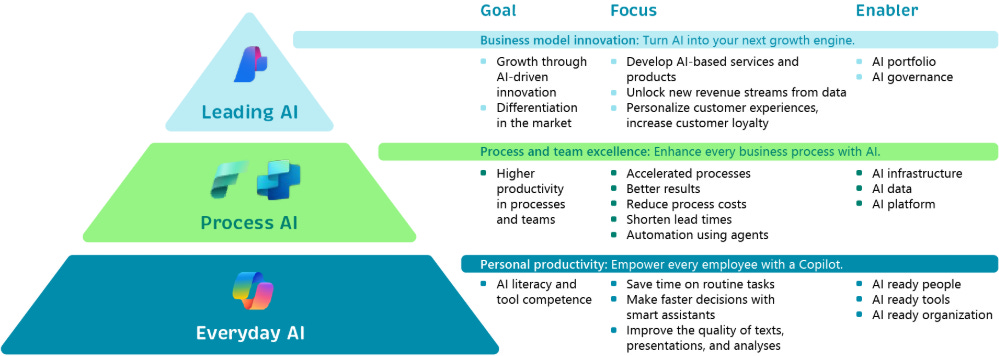
In my experience starting with Everyday AI includes also three other important aspects
AI Ready People
AI Ready Tools
AI Ready Organization
In every way, you are also preparing your organization to scale with AI in the future. Therefore, Microsoft offers a comprehensive platform that includes Copilot Chat, M365 Copilot, Copilot Studio, and Microsoft Foundry.
Personal Note
💡 As a final note, here’s an important reminder:
Frontier Firm is a practice and a mindset, not a status to be achieved.
What do I mean by that? The Frontier Firm journey is ongoing, so it’s not a status you achieve once and for all, but rather a practice you establish in your organization.
Ready to start your Frontier Transformation Journey? Subscribe this newsletter ✨